
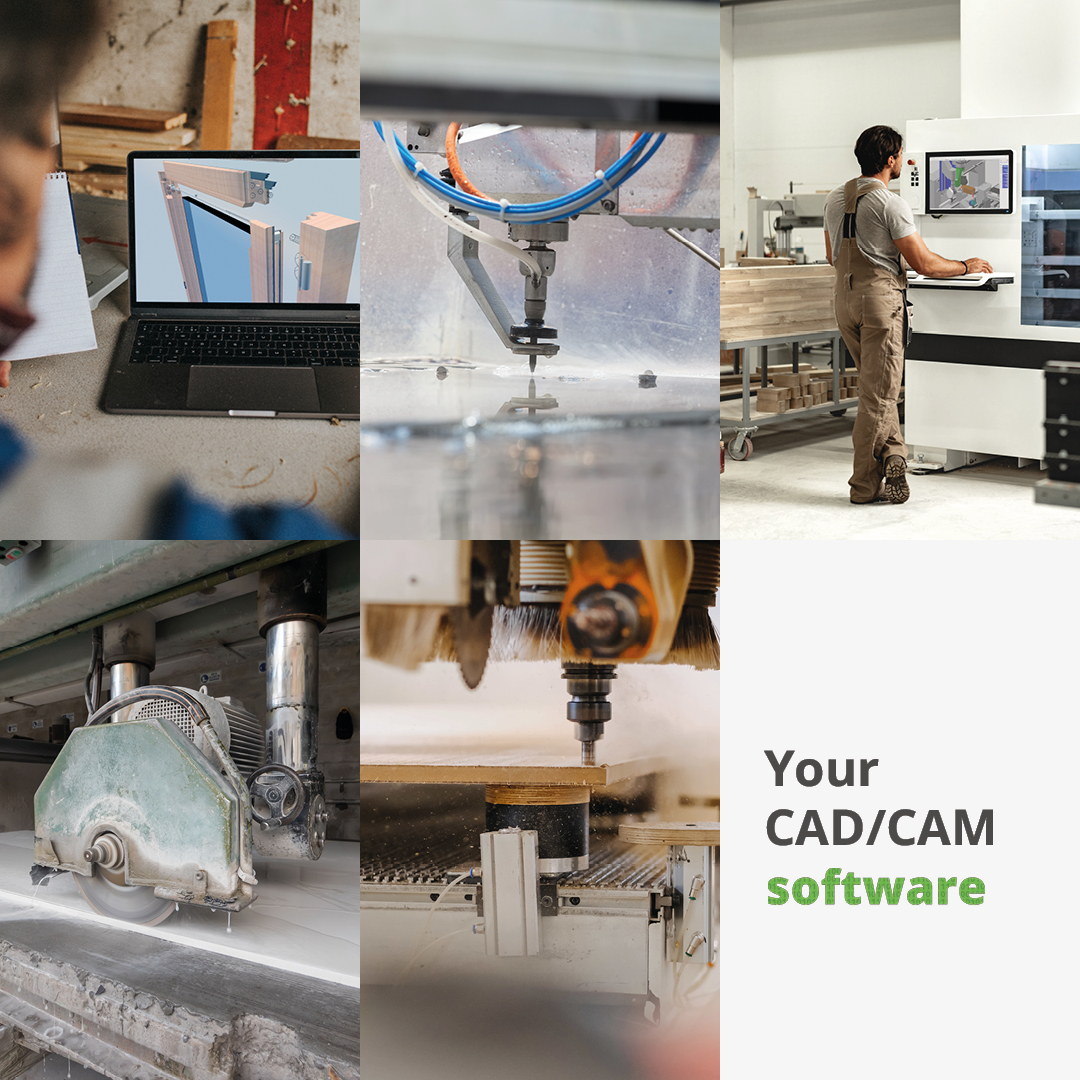
Digitalization forces companies to make a decision. On one side stands the adoption of general-purpose software that can cover different areas within a single working environment; on the other, the choice of specific-purpose software, designed for one particular manufacturing sector.
This is not a purely technical choice. It directly affects programming times, the quality of the finished part, and the margin on every job.
In this article we compare these two technologies, weighing their pros and cons to understand which is the best fit for your CNC production cycle.
Specific-Purpose and General-Purpose Software: Two Philosophies Compared
The fundamental difference between these two technologies lies in their design logic.
General-purpose software is built to integrate design and CAM programming tools that can be applied to different materials and industries, without committing to any single type of machining. Its strength is being cross-industry.
Specific-purpose software, on the other hand, is developed to fit the needs of one particular sector. Every function, operation, and automation is tailored to that type of production and material. Here, the strength is depth.
Understanding which way the balance tips between these two philosophies is the first step toward an informed choice.
What a Vertical CAD/CAM Solution Is and What It Does
A vertical CAD/CAM solution is designed for specific machining operations. It isn’t a generic software with a few themed commands bolted on, but an environment engineered to meet the technical needs of that production sector.
Specific purpose software knows the material inside out and understands:
- how a panel behaves during drilling;
- how to manage the toolpath on a marble slab;
- what the tolerances are for glass machining.
This knowledge translates into faster workflows and fewer manual operations.
Verticality as Technological Specialization
Specific-purpose software must have a technological architecture that integrates predefined work cycles and optimized post-processors for the target machine fleet. These two elements are essential to correctly translate geometry into machine language.
Cross-industry CAD/CAM requires the operator to manually build the very logic that a vertical CAD/CAM solution handles natively. The result is time saved on every job which, over the long run, translates into more efficient use of your CNC machines.
General-Purpose Software: The Advantages of Flexibility
Choosing general purpose software should not be seen as a fallback. In several contexts, in fact, it can prove a valid option with clear, objective advantages.
The benefits of a solution like this include:
- a single environment in which to work different products and materials. This versatility is essential for anyone with low-standardization production and mixed job orders.
- the streamlining of tools. There is a single software to manage, update, and oversee, with one interface logic to learn — well suited to limited production volumes and non-repetitive machining.
Naturally, the more specific, recurring, and technical the operations become, the greater the need for additional manual intervention. The flexibility of general purpose software then turns into a drain on time and energy, resulting in production that is increasingly complex to manage.
Specific-Purpose Software: The Advantages of Specialization
It is on the ground of specialized production that specific-purpose software shows its true value.
Its benefits have a direct impact on productivity, and they are:
- the automation of recurring production cycles. All the operations typical of the target sector are handled natively, drastically reducing manual steps.
- machining precision. Toolpaths are calibrated to the physical characteristics of the target material, ensuring greater accuracy even when producing the most complex geometries.
- the integration of specific purpose software with the CNC machine. Thanks to dedicated post-processors, the transition from CAD design to the CAM production stage is direct and effective, with a reduced margin of error.
Pros and Cons Compared: Wood, Stone and Glass
The comparison between vertical and general-purpose CAD/CAM software takes on a different shape depending on the material. Let’s look at the three main cases.
Wood Processing
When it comes to wood machining, there are specific operations that apply to the production of windows and doors, staircases, and furniture — namely drilling, milling, and joinery.
For wood production, vertical software can automate these cycles by linking them directly to the industry’s CNC machining centers. A general purpose solution, on the other hand, can perform the same operations, but it requires you to manually set up what a specific-purpose solution already includes in its configuration, lengthening programming times.
Did you know that adopting a dedicated software for wood machining can help you reduce waste, making your plant more efficient?
Stone Processing
Stone materials such as marble, granite, natural stone, and ceramics require specific toolpaths. Slabs are not uniform and, for this reason, vertical software is often the recommended choice for optimizing cuts and machining operations that are hard to replicate in a generic environment. Every peculiarity is handled automatically by a specific-purpose solution for stoneworking designed to meet the real production needs of the industry.
Glass Processing
Glass is a material that demands a high level of precision. The shift from manual sheet cutting to operations with modern CNC machines has made the need for dedicated software that handles drilling, cutting and grinding cycles even more apparent. This is why a dedicated glass processing solution proves more effective than a general-purpose one when it comes to reducing operational errors and scrap.
How to Choose Based on Your Production Flow
Beyond a purely theoretical comparison, the choice depends on the nature of the business. That said, there are criteria that can help you identify the most suitable solution for your production setup.
In particular:
- the degree of specialization of the machining;
- production volumes;
- the machine fleet;
- the level of operator autonomy.
At DDX we specialize in developing custom CAD/CAM solutions, designed to integrate within your production flow, whatever your machine fleet may be.
If you’d like to find out how we can support your production, get in touch with our team of experts.
Why Specialization Makes the Difference
The general rule is that the more vertical and repetitive your plant’s production, the more a specific-purpose software pays back the investment in terms of time and quality. For those aiming to produce more, better, and with fewer errors, verticality becomes a concrete competitive advantage.
When we talk about specific purpose and general purpose software, we are referring to two different approaches to production. While a general purpose solution offers flexibility — especially when machining varies and is not standardized — a specific purpose CAD/CAM offers depth, precision, and automation for specific industries.
If you want to compare the different vendors of specific purpose CAD/CAM software objectively, we’ve created a checklist that might be just what you need.